

The App Development Process Starts Before The First Line Of Code.
The app development process is more than designing a few screens and sending a project to a developer. A successful app starts with a real problem, a clear audience, a strong plan, and a purpose that makes sense beyond the excitement of the idea. Many apps fail because they are rushed into development before the business understands what users actually need, how the app will work, and what success should look like after launch.
Mobile app development can open the door to new revenue, better customer service, stronger brand loyalty, internal process improvements, and new business models. But it can also become expensive fast when the project has no clear structure. Features get added without purpose. Screens become confusing. Timelines stretch. Budgets move. The final product may launch, but users do not stay because the app was built around assumptions instead of real behavior.
A strong app development process gives the project direction. It moves from idea validation to planning, design, development, testing, app store optimization, launch, marketing, and long term improvement. Each step matters because every decision affects the user experience, the cost of development, and the future of the application.
Whether you are building a startup app, customer portal, SaaS platform, booking system, marketplace, ecommerce app, internal business tool, or hybrid mobile application, the process should be organized from the beginning. The goal is not just to launch an app. The goal is to build something people understand, trust, and continue using.
Good App Ideas Solve Specific Problems For Real Users.
The first stage of the app development process is validating the idea. This means asking whether the app solves a real problem, who needs it, how often they would use it, and why they would choose it over another option. A good idea does not have to be completely new, but it does need to be useful, clear, and easier for the target audience to understand.
Many founders and business owners start with features instead of problems. They imagine dashboards, messaging, payments, profiles, notifications, maps, subscriptions, artificial intelligence, and account portals before they have confirmed the basic reason someone would open the app. Features matter, but they should support the problem being solved. They should not replace strategy.
Research helps separate a strong app idea from an expensive guess. This can include competitor research, customer conversations, surveys, market reviews, search behavior, pricing research, and early prototype feedback. The point is to understand what users are frustrated with, what they already use, what they wish worked better, and what would make them trust a new solution.
For startup app development, validation is especially important because early budgets are usually limited. A smaller, focused version of the app can often prove the idea faster than a large build packed with every possible feature. The more clearly the problem is defined, the easier it becomes to plan the product, control the budget, and launch with confidence.
A Clear Plan Keeps The App From Growing Out Of Control.
Once the app idea has been validated, the next step is planning. This is where the project moves from a broad concept into a working roadmap. Planning defines what the app will do, who will use it, what roles are needed, what features belong in the first version, what can wait until later, and how the application will support the business behind it.
One of the most important planning decisions is the Minimum Viable Product, often called the MVP. The MVP is not a low quality version of the app. It is the most focused version of the product that solves the core problem. It gives users enough value to test the concept while giving the business real feedback before investing in a larger build.
Planning should also include user roles, account types, payment flows, admin features, notifications, app content, data storage, security needs, analytics, and third party integrations. If the app will include subscriptions, booking, messaging, ecommerce, user generated content, or location based features, those workflows should be mapped before development begins.
A detailed plan protects the project from scope creep. Without clear boundaries, app development services can quickly become more expensive because every new idea feels urgent. A good roadmap keeps the project focused on what must be built first, what supports launch, and what can be added after real users begin interacting with the product.
The App Development Process Should Move Through Clear Stages.
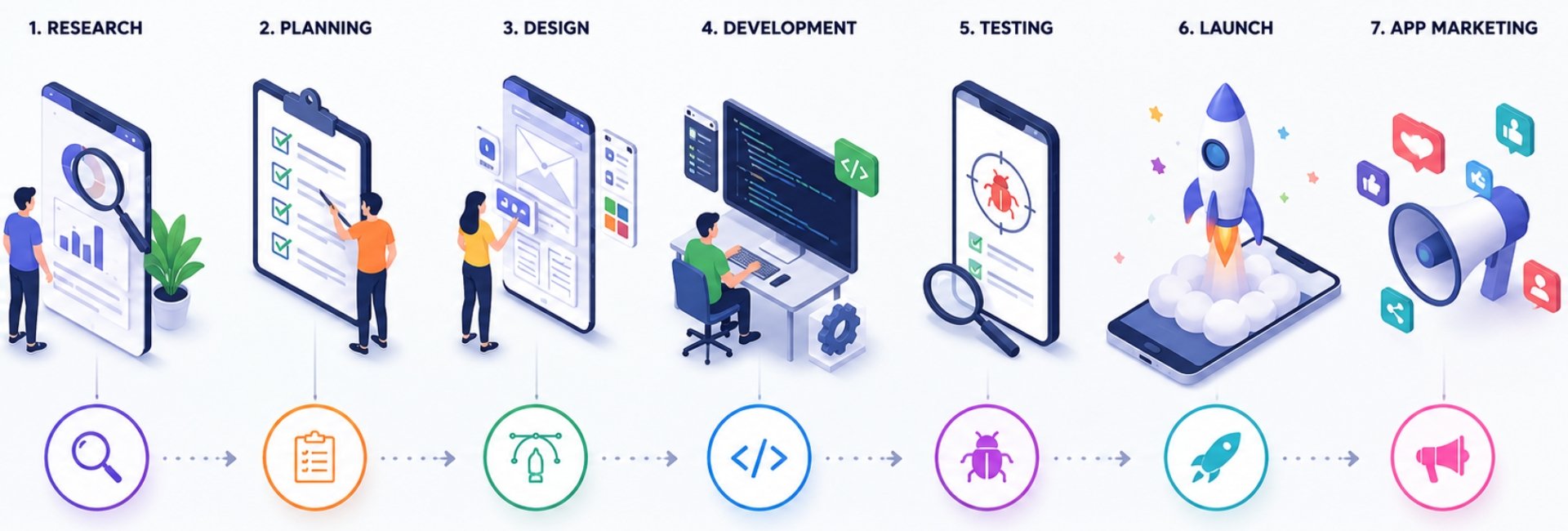
Every project has its own details, but most successful mobile app development projects follow a structured path from idea to launch and beyond.
- Validate the app idea by researching user needs, pain points, competitors, and market demand.
- Define the MVP so the first version solves the main problem without unnecessary features.
- Map user flows, account roles, app screens, business rules, and core functionality before design begins.
- Create wireframes and mobile app design prototypes that show how users will move through the app.
- Build the frontend, backend, database, authentication, integrations, and admin tools needed for the first release.
- Complete app testing across devices, screen sizes, user roles, operating systems, and real workflows.
- Prepare the app launch strategy with app store optimization, screenshots, descriptions, marketing, and support plans.
- Use feedback, analytics, reviews, and performance data to improve the app after launch.
This process helps reduce confusion and gives every part of the project a purpose. When the roadmap is clear, the team can make better decisions, protect the budget, and build an app that is easier to improve over time.
Mobile App Design Should Make The Experience Easy To Understand.
The app design process is where strategy becomes visible. This stage includes wireframes, screen layouts, navigation flow, visual direction, user interface design, and user experience decisions. Good mobile app design is not only about making screens attractive. It is about making the app easy to use without forcing users to think too hard.
A user should understand what to do next. Buttons should be clear. Menus should be simple. Forms should feel manageable. Important actions should not be buried. If users need instructions to complete basic tasks, the design needs more work. The best app interfaces feel natural because the planning behind them was handled carefully.
Wireframes are useful because they allow the team to review the structure before visual design and development begin. They show where content, buttons, forms, menus, and features will live. This makes it easier to catch confusing workflows before they become expensive to rebuild.
Prototypes take the design further by allowing stakeholders and test users to click through the app experience. This can reveal missing steps, unclear labels, weak onboarding, or screens that feel too crowded. The design phase should answer an important question before development begins: can a real user move through the app without confusion?
Development Turns The Plan Into Working Software.
After planning and design, the development phase begins. This is where the application is built across the frontend and backend. The frontend includes the screens users interact with. The backend manages data, user accounts, permissions, payment logic, notifications, APIs, admin tools, and the business rules that power the application.
The technology used depends on the goals of the project. Some apps need native development for iOS and Android. Others can be built as hybrid mobile apps using tools such as React Native, Flutter, or progressive web app technology. A SaaS platform may need a web application, admin dashboard, database, cloud hosting, payment system, and mobile friendly user experience.
Custom app development should be built with future growth in mind. An app may start with a small group of users, but the backend should be planned so it can handle more accounts, more data, more transactions, and more activity if the product grows. Poor structure early can lead to expensive rebuilds later.
Security also belongs in the development phase, not after launch. Authentication, password handling, user roles, database permissions, payment processing, encryption, and privacy decisions should be part of the build from the start. If users are trusting the app with personal information, payments, messages, photos, health details, location data, or business records, the application needs careful protection.
App Testing Helps Prevent Launch Day Problems.
Testing is one of the most important parts of the app development process. Even a strong development team can miss bugs because apps have many moving parts. Users may register, reset passwords, upload files, make payments, send messages, change settings, receive notifications, or move between devices. Every workflow needs to be tested before launch.
App testing should include functional testing, usability testing, performance testing, compatibility testing, security testing, and device testing. The app should be reviewed on different screen sizes, operating systems, browsers, and account types. If there are customer accounts and admin accounts, both sides of the experience must be tested carefully.
Quality assurance is not only about finding bugs. It is about protecting the user experience. A button that does not work, a form that fails, a slow screen, a confusing message, or a broken payment flow can damage trust immediately. Users are often less forgiving with mobile apps because they expect them to work quickly and clearly.
Beta testing adds another layer of protection by allowing real users to try the app before the public launch. Their feedback can reveal confusing screens, missing features, unclear wording, slow steps, and unexpected behavior. This feedback gives the team a chance to fix problems before reviews and ratings are affected.
App Store Optimization Helps The Right Users Find The App.
App store optimization, often called ASO, helps improve how an app appears and performs inside the Apple App Store and Google Play. A well built app still needs to be discoverable. If users cannot find it, understand it, or trust it from the listing page, downloads will be harder to earn.
ASO includes the app title, subtitle, description, keywords, category, icon, screenshots, preview videos, and reviews. The listing should explain what the app does, who it helps, and why someone should download it. Clear screenshots are especially important because many users scan visuals before reading the full description.
The app launch strategy should include ASO before the app goes live. Waiting until the last minute can lead to rushed descriptions, weak screenshots, and unclear messaging. The app page is part of the user journey, so it should be treated with the same care as the app itself.
ASO also continues after launch. Keywords, screenshots, conversion rates, reviews, and user behavior can change over time. Monitoring performance helps the team improve visibility and turn more app store visitors into users.
A Strong Launch Needs More Than Pressing Publish.
App marketing should begin before launch. Many businesses make the mistake of building the app first and thinking about users later. By the time the app is ready, there may be no audience waiting, no landing page, no email list, no content plan, no launch message, and no clear reason for people to try it.
A better app launch strategy builds awareness early. This can include a landing page, waitlist, social content, email updates, beta invitations, demo videos, founder updates, customer education, paid ads, local promotion, influencer outreach, or partnerships with organizations that already reach the target audience.
The marketing plan should connect directly to the purpose of the app. A fitness app, marketplace, business tool, education platform, booking app, and SaaS product all need different messaging. The audience should understand the problem being solved within seconds.
After launch, marketing should continue with user feedback, reviews, content, paid acquisition, retention campaigns, onboarding improvements, and feature announcements. Getting downloads is only part of the work. Keeping users engaged is where long term growth happens.
The Right App Can Support Revenue, Service, And Growth.
A well planned app can support a business in several ways. It can create a new revenue stream, improve customer communication, reduce manual work, support subscriptions, simplify booking, organize data, improve customer loyalty, or make internal operations easier. The value depends on how clearly the app connects to the business model.
For startups, the app may be the business. In that case, the app development process must include revenue planning, user acquisition, product feedback, retention strategy, and investor ready documentation. For existing businesses, the app may support customer service, ecommerce, memberships, training, scheduling, or internal productivity.
This is why the business side cannot be separated from development. An app that looks good but has no clear monetization plan may struggle. An app with strong features but poor onboarding may lose users. An app with a good idea but weak marketing may never reach the audience it was created for.
The strongest app development services consider both the software and the business behind it. The app should be built to work for users and support the company operating it.
The App Development Process Is About Building Something People Keep Using.
The app development process does not end when the app goes live. Launch is only the start of the next phase. Once real users begin interacting with the product, the team will learn what works, what needs improvement, what features matter most, and where users may be getting stuck.
Strong apps improve over time. They use analytics, reviews, user feedback, support requests, and performance data to guide updates. This ongoing work can include bug fixes, design improvements, speed improvements, new features, better onboarding, stronger notifications, and improved app marketing.
The most successful applications are not built from guesswork. They are built from a clear process that connects research, strategy, design, development, testing, launch, and growth. Every stage helps reduce risk and create a better product.
If the goal is to create an app that users trust, download, and return to, the process matters. Build with purpose. Validate the idea. Plan the first version carefully. Design around real user behavior. Test before launch. Market with clarity. Then keep improving based on what users actually do.
